


Key Highlights
- Jimmy Wales stated that Bitcoin is a failure as a currency and a store of value.
- In recent months, BTC has witnessed growing institutional adoption and declining volatility trends
- BTC’s on-chain transaction activity shows impressive network usage, but its real-world utility as a medium of exchange remains limited by scalability limitations
On February 27, Jimmy Wales, American internet entrepreneur and Wikipedia Co-Founder, shared a shocking remark on Bitcoin’s future, which sparked a discussion in the crypto community. In his latest remark, Jimmy Wales stated that Bitcoin is “a complete failure as a currency, as a store of value.” He also affirmed that BTC is not going to become the dominant money in the future.
People who think that Bitcoin is going to zero are likely mistaken. The design is robust enough that it will continue to exist in perpetuity, barring some currently unforeseen breakdown in cryptography or a surprise 51% attack (even then, a fork would carry on I would imagine).…
— Jimmy Wales (@jimmy_wales) February 25, 2026
Nevertheless, Jimmy Wales has refuted a popular claim that BTC would eventually go to zero, calling it “likely mistaken.” He said, “The design is robust enough that it will continue to exist in perpetuity.”
While at first this claim sounds unrealistic based on the current market conditions, lately its institutional adoption and mainstream adoption have grown at an unusual pace. Many public companies have started accumulating, following the footsteps of Michael Saylor’s Strategy. At present, corporate treasuries are holding around 5% supply of BTC, which is around 1,061,697 BTC.
BTC Sees Growth in On-Chain Activities, But Real-World Use is Limited
As mentioned in the original white paper, the original vision of Bitcoin was to create a decentralized, peer-to-peer electronic cash system to make online payments. This is done by using BTC to transact directly from one party to another without any intervention of third parties like a financial institution or central authority.
Bitcoin’s on-chain transaction activity is showing abnormal growth, but its real-world use as a medium of exchange is still limited by scalability limitations and competition from more stable alternatives like stablecoins.
As of February 24, Glassnode data shows that the transfer volume of Bitcoin is approximately around 425,509 BTC per day, which shows that it is being used for high-value settlements but not for everyday payments.
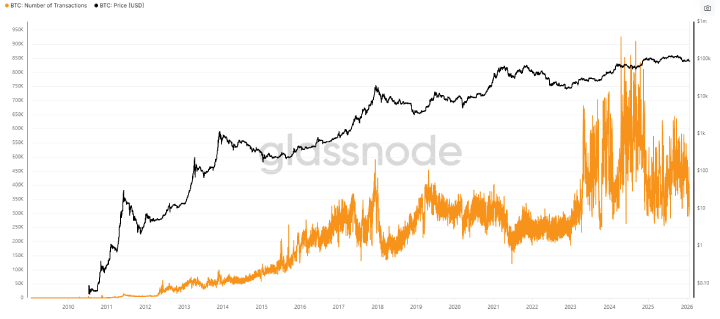
(Source: Glassnode)
Daily confirmed transactions averaged around 484,761 in mid-February, which is down from its high of above 700,000 in 2025. Still, this is up by 13.42% year-over-year per MEXC metrics, with a transaction rate of about 5.93 transactions per second as of February 19.
This is equally around $19 trillion in settlement transactions value yearly, which is similar to $19 trillion in 2024 via Market Data Forecast and Chainalysis reports. This figure is surpassing many traditional payment networks in gross volume.
On the other hand, Bitcoin’s Layer-2 scaling solution, the Lightning Network, has also witnessed an explosive growth after its launch because of its capability to execute cheap micro-transactions.
According to River Financial’s February 2026 report, Lightning has processed approximately $1.17 billion in monthly volume across 5.22 million transactions in November 2025, which is a 300% year-over-year increase in payments. With average transaction values of around $223.
Chainalysis reported that global BTC payments via Lightning surged 74% year-over-year.
However, the number of daily transactions of BTC is not that impressive. According to the Security.org and Triple-A report, Bitcoin is only responsible for 1% of global daily transactions compared to fiat’s 99% dominance.
In the U.S., 30% of adults, which is around 70.4 million people, own crypto. While this is around 27% up from 2024, its retail usage is still very low. Only 28% of Americans actively use it for payments, according to Security.org’s 2026 report.
The rise of stablecoin-based payments also affected the crypto-based payments. According to Coinbase Institutional Outlook, stablecoins are handling 40% of crypto trading volume and dominate payments due to price stability. At the time of writing, the cumulative market capitalization of the stablecoin market is around $300 billion. Bitcoin’s base layer processes about 7 transactions per second. This is too low against Visa’s 65,000.
These numbers are making clear that Bitcoin has impressive settlement volume but still falls short as an everyday medium.
Bitcoin Sends Mixed Signals as a Store of Value
Bitcoin is providing mixed signals as a store of value, with institutional accumulation providing long-term support. However, this also inflects volatility and 2026’s sharp downfall, sparking short-term reliability.
As of February 26, 2026, Bitcoin trades around $68,300 according to Coingecko, down 24% year-to-date from January 1 levels near $90,000. This is its worst annual start on record.
This follows a 50% drawdown from its October 2025 all-time high of $126,080. Intraday lows have been brutal, hitting $63,822 on February 23 and February 5, according to CoinGlass.
In comparison to other assets, Gold has risen 61% year-to-date, while the S&P 500 posted mid-teens gains. This shows Bitcoin’s underperformance during periods of macroeconomic stress.
Conclusion
As of now, Bitcoin has not truly failed as a form of money, but there is truth that it is performing unevenly. It is performing as a long-term store of value with growing institutional adoption and declining volatility trends, while Lightning Network improvements show its interest for medium-of-exchange in specific areas like remittances and micropayments.
Rather than a clear failure, BTC is evolving as a “digital gold” with settlement-layer utility rather than a perfect everyday money. Yes, it falls short for daily use today. Also, the rise of stablecoins has raised questions about their long-term utility. However, institutional adoption of BTC and National-level treasuries are enough to fuel its growth.
Also Read: AI as On-Chain Security Oracle for Real-Time Alert
See less
