






Key Highlights
- After a military intervention that captured President Nicolás Maduro, the U.S. government is exploring plans to seize Venezuela’s Bitcoin reserve
- Reports suggest that the country secretly accumulated a huge Bitcoin stockpile by converting illegal gold mining revenue and oil payments into crypto, approximately around 600,000 BTC
- The threat of seizure comes after Bitcoin’s price surge past $94,000
Amid the ongoing global tension, the latest report suggests that the U.S. government might seize Venezuela’s Bitcoin reserves after capturing the country’s President Nicolás Maduro.
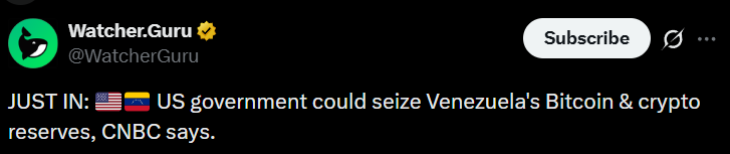
(Source: Watcher.Guru on X)
According to a report from CNBC, U.S. authorities are exploring plans to seize Venezuela’s enormous stockpile of Bitcoin. This potential move, after a recent military intervention, could also make it a new frontier in the use of international sanctions, directly targeting a nation’s digital currency reserves.
The discussion of this asset seizure created immediate ripples through the cryptocurrency market. Bitcoin’s price quickly surged above $94,000 and is currently settled near $94,376, according to CoinMarketCap.
Venezuela Reportedly Holds Staggering Bitcoin Reserve
The discussion of the potential U.S. seizure is a clandestine treasure trove of Bitcoin. Multiple reports show that the Venezuelan government, under Maduro, secretly accumulated approximately 600,000 Bitcoin. At the current price, this stockpile is valued between $56 billion and $67 billion.
Venezuela: The $60B+ Bitcoin “Shadow Reserve”
Markets focus on the $17T+ in Oil that Venezuela owns.
But what they don’t know is that Venezuela one of the largest active $BTC holders in the world.
Similar in scale to both $MSTR and Blackrock.
Here’s how this impacts markets… pic.twitter.com/lf7CMUgtUB
— Serenity (@aleabitoreddit) January 4, 2026
This “shadow reserve” vastly exceeds the country’s officially declared holdings of just 240 Bitcoin. Some analysts believe that this secret accumulation began around 2018. The Maduro regime allegedly started converting proceeds from illegal gold mining operations into Bitcoin as a way to circumvent U.S. economic sanctions. Their strategy expanded to include requiring some international buyers of Venezuelan oil to pay in cryptocurrency, which was then swapped for Bitcoin.
“Intelligence reports indicate that the Venezuelan regime accumulated a “shadow reserve” of Bitcoin (BTC) and Tether (USDT) estimated at more than $60 billion. (HUMINT). his hoard was built through “gold swaps” and the requirement that oil exports be settled in USDT to evade sanctions,” Serenity stated on X.
“The regime likely converted ~$2B of gold proceeds into Bitcoin at an average price of $5K, which would have been around 400,000 BTC. At Jan 2026 price of ~$90K, that specific tranche alone would be worth $36B,” stated in the post.
To build this reserve, Venezuela became a pioneer in state-sponsored cryptocurrency mining. The country enlisted its military to run mining operations, using cheap hydroelectric power from the Guri Dam. This hidden treasury represents about 3% of all the Bitcoin in circulation, potentially making Venezuela one of the largest single holders in the world.
US Military Intervention in Venezuela
The financial threat of Bitcoin seizure comes after direct military action. Relations between the U.S. and Venezuela deteriorated rapidly over the weekend. On January 3, United States forces conducted airstrikes on targets in the capital city of Caracas. The stated purpose was to dismantle drug trafficking networks linked to the government of President Nicolás Maduro.
In a war-like raid, U.S. special operations teams successfully captured Maduro and his wife, Cilia Flores. They were extracted from the country and taken to New York, where they now face federal criminal charges for narcotics trafficking and money laundering. The operation was authorized by President Donald Trump. The country’s new acting president, Delcy Rodriguez, has since taken control and has indicated a new willingness to cooperate with the United States on economic matters.
The United Nations Security Council held an emergency meeting, where Secretary-General Antonio Guterres condemned the action and warned it could lead to major regional instability. Many nations have criticized the intervention as a violation of the country’s sovereignty.
Amid the ongoing chaos between America and the U.S., the sharp rise in Bitcoin’s price is showing that traders are speculating that locking up such a large amount of Bitcoin would reduce its available supply.
Some experts affirmed that the U.S. would likely use existing sanctions frameworks, similar to those applied to Russian assets. The primary difficulties would involve locating the digital wallets holding the Bycoin, which are probably secured in cold storage systems.
Also Read: Arbitrum ProxyAdmin Hack Steals $1.5M From USDGambit and TLP

